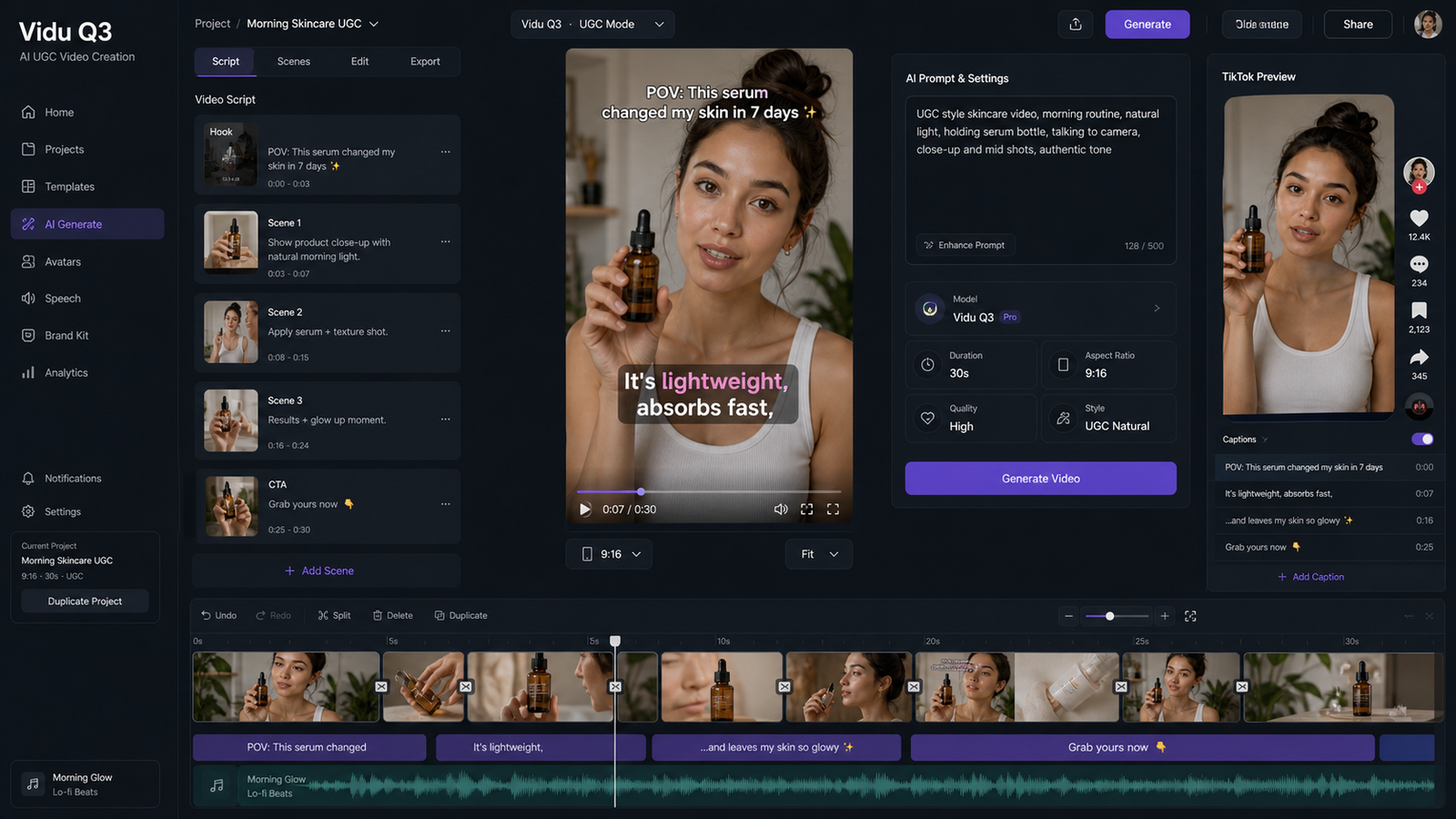
UGC video creation with Vidu Q3 is most useful when creators, e-commerce sellers, and marketers need fast short-form ad drafts with synchronized visuals and audio. Instead of waiting for a full creator shoot, teams can test TikTok-style product demos, AI try-on fashion clips, creator storytelling, and vertical product ads with a prompt-driven workflow on AITryon.Art.

This guide explains how a Vidu Q3 AI UGC workflow fits TikTok ads, Reels content, product demos, AI creator videos, and e-commerce testing. It also covers where AI UGC still falls short, because current AI creator video workflows are best for rapid testing and scalable experimentation, not for replacing every professional shoot.
What Is Vidu Q3 for AI UGC Video Creation?
Vidu Q3 is a short-form AI video model positioned around fast multimodal video creation, including synchronized audio and video generation. Vidu's official Q3 messaging highlights native audio generation, audio-video sync, camera control, multilingual capability, multi-speaker support, and short cinematic sequences. For UGC-style ads, that combination matters because the creator look depends on motion, voice, pacing, and product focus working together.
In practice, a Vidu Q3 AI UGC Video Generator workflow is not just "make a video." It is closer to creating a fast draft of a creator-style ad: product in hand, vertical framing, casual narration, subtitle-ready pacing, and a clear CTA. That makes it useful for TikTok advertisers, Shopify sellers, fashion brands, beauty brands, content studios, and agencies testing multiple ad angles.
AITryon is a good fit for this because its broader platform is built around AI try-on, fashion visuals, product content, and video generation. Use AITryon.Art when the goal is a practical AI creator video workflow for product showcases, fashion try-on UGC videos, and vertical short-form ads.

Why Synchronized Audio and Video Matter for Creator-Style Ads
Synchronized audio and video matter because UGC ads are judged by timing. A product reveal, voiceover line, gesture, subtitle beat, and CTA all need to feel connected. When the audio feels detached from the visual action, the ad looks like a template instead of a creator-style video.
This is where an AI video generator with audio can help. A workflow that supports AI video with synchronized audio lets marketers test narration, ambient sound, and creator-style pacing earlier in the draft process. For a TikTok ad, that can mean testing whether the hook lands in the first few seconds, whether the product appears at the right moment, and whether the voice direction supports the CTA.
Good AI TikTok creator videos usually need:
- A product or problem shown quickly.
- Natural handheld or mobile-style camera movement.
- Creator narration that matches the action.
- Subtitle-friendly sentence pacing.
- A clear CTA such as "try it today," "shop the look," or "see the before and after."
The caution is that audio sync does not automatically make a video publish-ready. You still need to review lip movement, hand motion, product accuracy, voice tone, captions, platform policy, and whether any claim needs legal or brand approval.
How to Use AITryon for Vidu Q3 TikTok Ads and Product Demos
Use AITryon's Vidu Q3 workflow when you need to turn a product idea into a vertical ad concept quickly. The best starting point is a clear brief: product, audience, creator style, key benefit, proof angle, desired camera movement, audio direction, and CTA.
A practical workflow looks like this:
- Choose the product or scene: skincare bottle, clothing item, gadget, coffee product, fitness accessory, or service result.
- Define the creator style: casual reviewer, excited unboxing creator, fashion try-on influencer, beauty tutorial host, or faceless product narrator.
- Set the format: 9:16 TikTok/Reels, mobile framing, quick cuts, subtitle-ready pacing.
- Add synchronized audio direction: casual voiceover, ambient sound, short dialogue, product reaction, or CTA narration.
- Generate several drafts with small prompt changes.
- Review realism, product accuracy, hands, text, voice timing, and platform compliance.
- Edit the best draft with captions, brand-safe claims, landing-page CTA, and final ad formatting.
For deeper prompt structure, use AITryon's related guide: AI TikTok UGC Video Maker: AITryon Prompt Templates and Workflow. It is the most relevant follow-up when you want AI TikTok UGC video generator prompts, UGC video prompts, and a repeatable AI product ad workflow.

Prompt Formula and Copy-to-Use Vidu Q3 UGC Prompts
The best prompts for AI short-form ad generation describe the product, creator style, camera movement, audio direction, platform format, and CTA in one compact brief. Use this reusable formula:
[product/scene] + [creator style] + [camera movement] + [audio/dialogue direction] + [platform format] + [CTA]
Copy-to-use prompts:
- Create a TikTok-style UGC ad for [product] with natural handheld camera motion, casual creator narration, and a strong CTA.
- Generate a creator-style unboxing video for [product] with realistic reactions, close-up product shots, and subtitle overlays.
- Create a short-form skincare testimonial video with authentic social-media pacing and synchronized voice narration.
- Produce a fashion try-on UGC clip featuring smooth outfit transitions, vertical framing, and influencer-style presentation.
- Generate a 9:16 TikTok ad showing problem -> solution -> CTA for [product/service].
- Create a realistic AI creator video reviewing [product] with conversational dialogue and natural gestures.
- Generate a cinematic UGC-style coffee shop lifestyle clip with ambient sound and creator narration.
- Create a social-media-style product demo with quick cuts, energetic pacing, and modern TikTok editing rhythm.
- Produce a creator-style AI ad for [brand] with subtle humor, mobile framing, and natural lighting.
- Generate an AI beauty product tutorial with close-up shots, creator narration, and polished vertical-video composition.
For Vidu Q3 TikTok video generator workflows, keep the first version simple. One product, one scene, one creator persona, one CTA, and one audio direction are enough. After you get a usable draft, create variations for hook, pacing, product angle, CTA, and audience segment.
AI UGC vs Traditional Creator Production
AI-generated UGC is faster and easier to scale than traditional creator production, but it does not offer the same authenticity, legal clarity, or human performance reliability. Traditional UGC still wins when a real person, real product use, exact testimony, regulated claim, or long-term creator relationship matters.
AI UGC is strongest for:
- Rapid ad concept testing before booking creators.
- Product demo drafts for internal review.
- Fashion AI video ads and AI try-on UGC videos.
- AI e-commerce product videos for testing angles.
- AI clothing promo videos and beauty tutorial drafts.
- Creator-style ads for hook, CTA, and pacing experiments.
Traditional creator production is stronger for:
- Real testimonials and trust-building social proof.
- Regulated industries that require careful claims.
- Complex product handling or physical demonstration.
- Long-form content with continuity across scenes.
- Brand partnerships where audience trust depends on the creator.
Reddit creators and AI UGC communities frequently discuss using AI workflows for scalable TikTok-style ads, especially when the goal is rapid iteration and low-cost testing. That is a useful signal of market interest, but it should not be treated as proof that AI UGC is automatically better than creator production. The best teams use AI to test ideas faster, then decide which concepts deserve human production, paid media spend, or professional editing.

Strengths and Limitations of Current AI UGC Workflows
The biggest strength of Vidu Q3-style AI UGC is speed. A marketer can test several hooks, product angles, creator personas, and visual styles before committing budget to a full shoot. This is especially useful for TikTok ads, Reels, Shorts, fashion promos, and AI product storytelling videos where creative testing matters more than one perfect hero film.
Other strengths include:
- Faster product demo ideation.
- Lower-friction vertical video testing.
- Audio and video direction in one prompt.
- Camera control for short cinematic sequences.
- Scalable ad variations for different audiences.
- Better fit for AI try-on fashion clips and product showcase videos.
The limitations are just as important. AI UGC still struggles with perfect hand motion, realism consistency, product detail accuracy, and long-form continuity. It can also produce unnatural facial expressions, odd object interactions, incorrect text, or visual artifacts that a viewer notices immediately.
Use AI-generated UGC for rapid testing, prototyping, and scalable ad experimentation. Use human editing, brand review, and prompt iteration before publishing. For paid ads, also check claims, permissions, privacy, music rights, platform policies, and whether the video implies a real testimonial that does not exist.
Best Use Cases for AITryon, Vidu Q3, and Short-Form AI Ads
AITryon's Vidu Q3 workflow is most useful when the output needs to look like short-form creator content rather than a polished Hollywood commercial. TikTok and Reels viewers often respond to directness, mobile framing, and natural pacing, so an overproduced visual can feel less native than a clean creator-style product demo.
Best use cases include:
- TikTok-style product demos: show a product, problem, key benefit, and CTA in a vertical ad.
- UGC ad drafts: test hooks, voiceover direction, and product angles before a full shoot.
- AI try-on fashion clips: create outfit transitions, clothing promo videos, and style showcases.
- AI creator storytelling: turn a product into a mini story with narration and mobile framing.
- Product showcase videos: create short clips for product pages, paid social, and landing pages.
- Vertical short-form ad generation: produce multiple 9:16 ad concepts for testing.
For e-commerce sellers, the most efficient approach is to create a batch of concepts around one product. For example, test one problem-solution ad, one unboxing video, one testimonial-style clip, one AI try-on clip, and one lifestyle product demo. Then use performance data or team review to decide which angle deserves more editing or human production.
FAQ
Is Vidu Q3 good for AI UGC videos?
Vidu Q3 is a strong fit for AI UGC drafts because it supports short-form video workflows with synchronized audio and video direction. It is best used for rapid testing, product demo drafts, TikTok-style ads, and creator-style concepts rather than fully replacing human production.
Can I use Vidu Q3 for TikTok ads?
Yes, Vidu Q3 can be used for TikTok-style ad drafts, especially when you write prompts around vertical framing, creator narration, product demonstration, and a clear CTA. Always review the final output for accuracy, artifacts, claims, and platform policy compliance.
Why does synchronized audio matter for AI creator videos?
Synchronized audio helps the video feel closer to creator content because narration, gesture, product reveal, and CTA timing work together. Without good timing, an AI UGC video can feel disconnected or template-like.
Does AI UGC replace traditional creators?
Not completely. AI UGC is useful for prototyping and scalable ad testing, while traditional creators are still better for real testimonials, authentic audience trust, complex product handling, and brand partnerships.
What should I check before publishing AI-generated UGC?
Check product accuracy, hand motion, facial realism, audio timing, captions, claims, copyright-sensitive elements, privacy, platform rules, and whether the ad could mislead viewers about a real creator or customer experience.
Conclusion
UGC video creation with Vidu Q3 gives creators and marketers a faster way to test TikTok ads, product demos, AI try-on fashion clips, and creator-style videos. The workflow is strongest when used for rapid iteration: prompt, generate, review, edit, and compare. For teams that want AI product demo videos, AI TikTok creator videos, and scalable short-form ad concepts, AITryon.Art is a practical place to start with Vidu Q3 while keeping human review in the loop.